Carpooling vs. Ride-Hailing: Real Cost Comparison in Lahore

Every commuter in Lahore is running the same math whether they realize it or not: how much is getting to work actually costing me every day? The honest answer depends entirely on which of the three ways you get there — driving yourself, hailing a ride, or sharing a seat — and the gap between them is bigger than most people assume.
One route, five ways to get there
Take a real commute: Bahria Town to Gulberg III, Lahore — a 30.60 km route. Here's what the same trip costs depending on how you make it.
Ride-hailing (AC ride)
Rs. 1,600 — for the full car and driver's time, solo.
Ride-hailing (Mini)
Rs. 1,350
Rickshaw
Rs. 1,100
Bike
Rs. 650
RideMate (per seat)
Rs. 645 — a fixed, upfront fare, still under bike money.
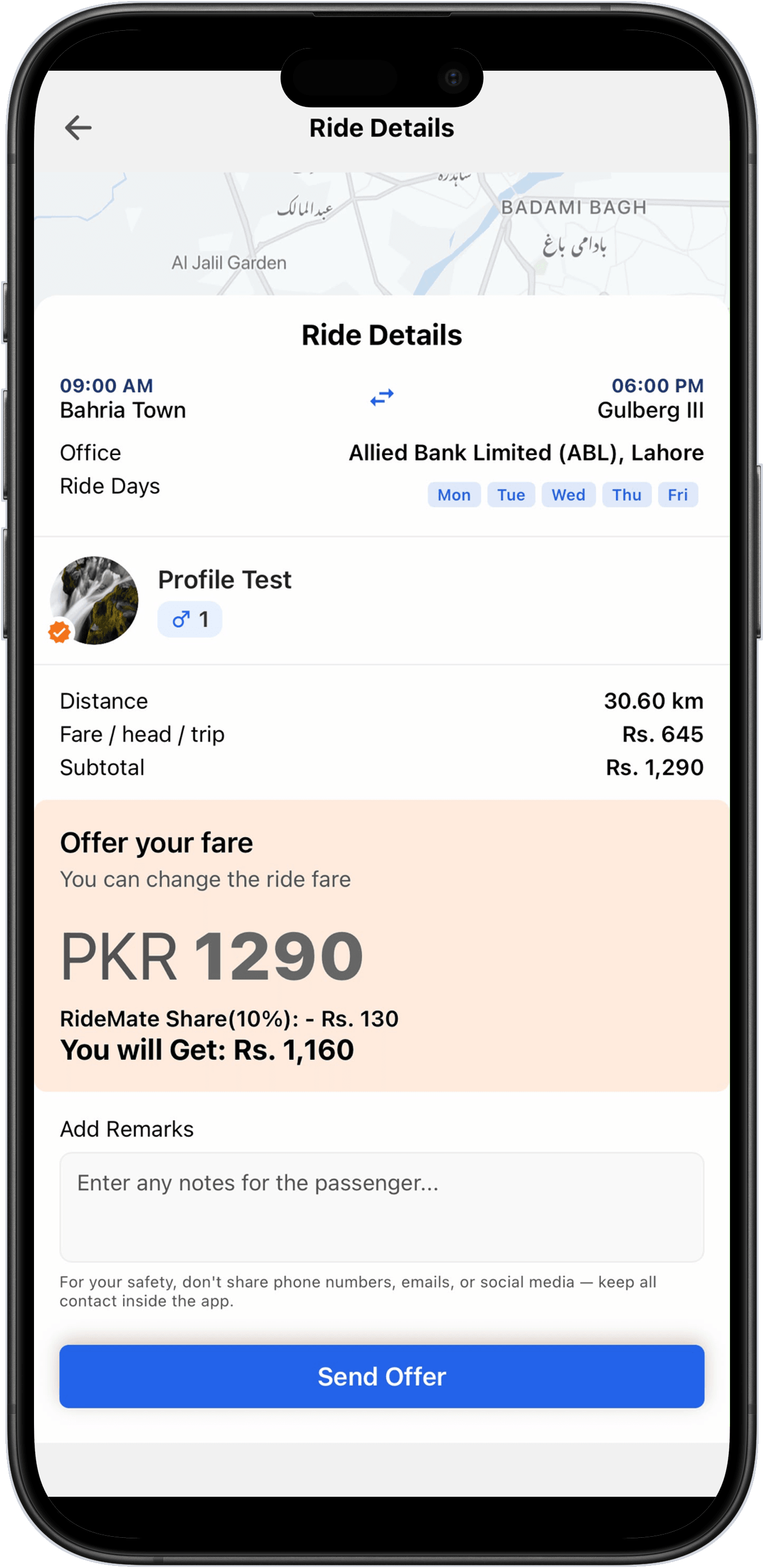
Rs. 645 versus Rs. 1,600 for the AC ride option on the same route — a nearly 60% saving, for a more comfortable ride than the bike or rickshaw next to it on this list.
Driving yourself isn't even in that comparison, and it doesn't come out ahead either: with petrol at Rs. 336.15 per litre and an average car doing 12 km per litre, that's about Rs. 28 per kilometre in fuel alone — so this 30.60 km trip costs roughly Rs. 857 in fuel, one way — before parking, wear on the car, or the return leg. RideMate is still the cheaper seat, and it's the only option on the list where you're not paying for an entire vehicle by yourself.
What a full month looks like
Numbers land differently over a full month. That Rs. 645 fare covers one leg — the evening return runs the same route, so a full commuting day on RideMate costs Rs. 1,290. Over 22 working days, that's Rs. 28,380 a month.
Compare that to driving yourself: at Rs. 28 per kilometre in fuel alone, the round trip (61.2 km) costs about Rs. 1,714 a day, or roughly Rs. 37,716 a month — and that's fuel only, before parking, maintenance, or wear on the car. Carpooling this exact route saves roughly Rs. 9,336 a month, and that gap only grows once you count everything solo driving costs beyond fuel.
Why ride-hailing costs what it costs
None of this is a knock on ride-hailing — it solves a real problem, especially for one-off trips at odd hours or to places you don't go regularly. But the Bahria Town–Gulberg numbers above show the structural issue plainly: one passenger absorbs the full cost of a vehicle, a driver's time, and the platform's take, for a single trip that exists only for them. Surge pricing on top of that means the same route can cost noticeably more depending on when you happen to need it.
Why carpooling is structurally cheaper
Carpooling doesn't beat ride-hailing on cost because of a promo code — it's cheaper because the cost of the trip is split across everyone on it. On RideMate, every fare is calculated per seat, per trip, from the actual route distance, and both sides see the same math: the fare per head, the subtotal, RideMate's 10% share, and exactly what the driver takes home. No hidden commissions, no surge, no guessing what the price will be on a Tuesday versus a rainy Friday.
The honest trade-off
Ride-hailing wins when you need to go somewhere once, right now, off your usual route — carpooling can't match that kind of on-demand flexibility. But for the trip most commuters actually take — the same route, roughly the same time, five days a week — that flexibility isn't what you're paying for. You're paying full solo price for a predictable trip, every single day. That's exactly the gap RideMate's Daily Route Rides are built to close: set your commute up once, and every day after that runs at a shared-seat price instead of a solo one.
See what your actual commute would cost as a shared ride — check your route on RideMate.