We're Not Building a Carpool App. We're Building Certainty.
Every morning in Lahore, Islamabad, Rawalpindi, and Karachi, the same scene plays out.
A car with three empty seats pulls out of a street in Johar Town. Two houses down, someone is opening a ride-hailing app and wincing at the fare. At the bus stop around the corner, a woman checks her watch and wonders if she'll make her 9am meeting.
They're all going to the same part of the city. They will never meet.
Multiply that by every street, every morning, every city — and you start to see the real size of the problem. Pakistan doesn't have a transport shortage. It has a coordination problem. The seats exist. The routes exist. What's missing is a way for strangers to trust each other enough to share the journey.
That's what RideMate is.
What 15,000 rides taught us
When we launched RideMate, we thought we were solving a pricing problem. Fuel is expensive, ride-hailing is expensive, so if we let commuters split the cost of a seat, everyone wins. Simple.
We were half right. The savings matter — our riders regularly pay a fraction of a solo ride-hailing fare. But when we actually talked to the people using the app (and the people who downloaded it and never booked), the objection was almost never price.
It was uncertainty.
Who is picking me up? Will they cancel? What if nobody accepts my request? What if I get late for work?
Nobody says no to saving money. People say no to risk. So somewhere along the way, we stopped thinking of ourselves as a carpooling app and started thinking of ourselves as a trust company that happens to move people.
How we built trust into the product
Trust isn't one feature. It's a hundred small decisions. Here's what that looks like inside RideMate today — not on a roadmap slide, but live in the app.
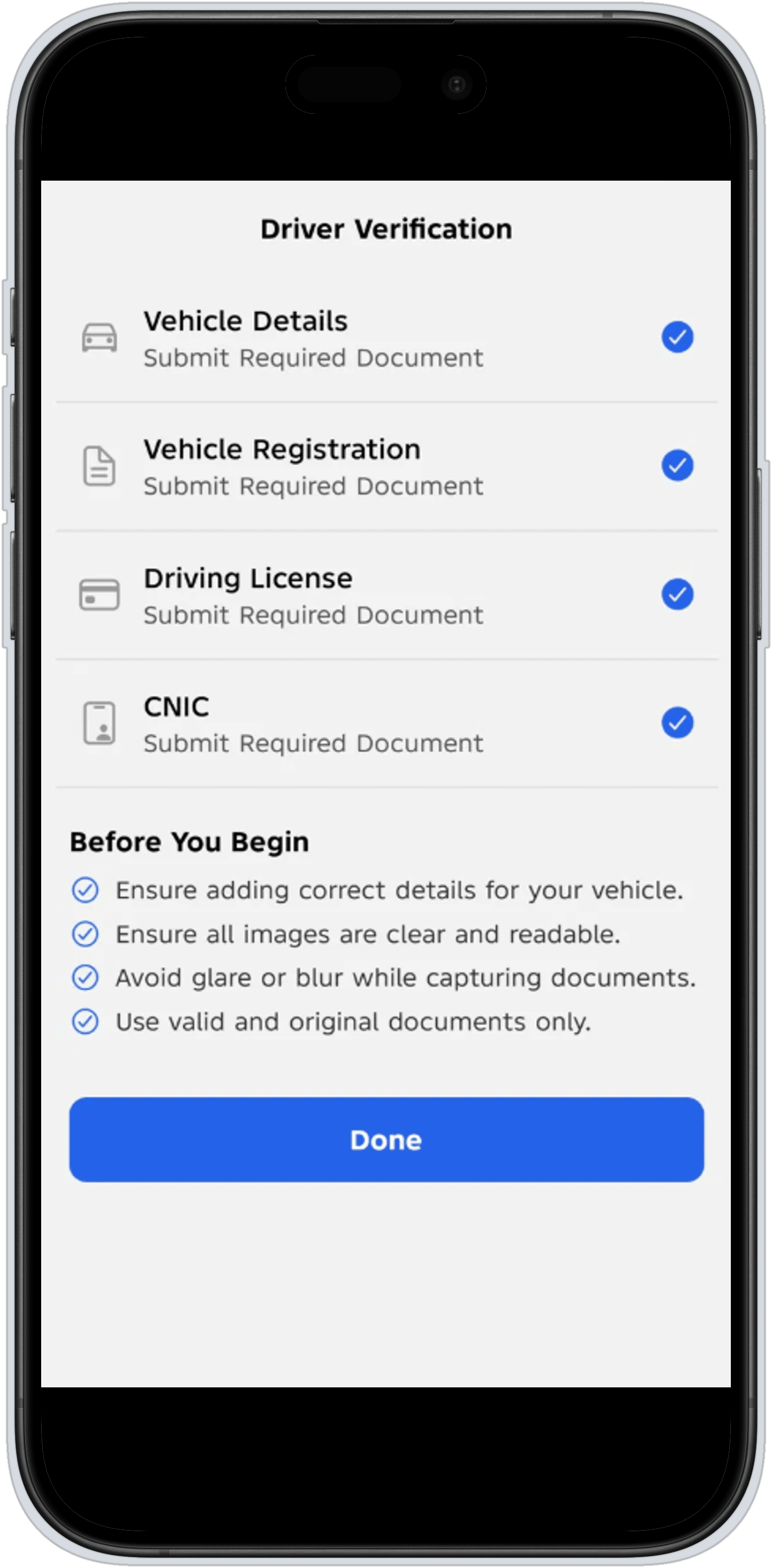
Every driver is verified before their first ride. Vehicle details, vehicle registration, driving license, and CNIC — all four documents are required before a driver can host a single ride on RideMate. Verified drivers carry a badge on their profile, so when you see the orange tick next to a name, you know we've checked who's behind the wheel.
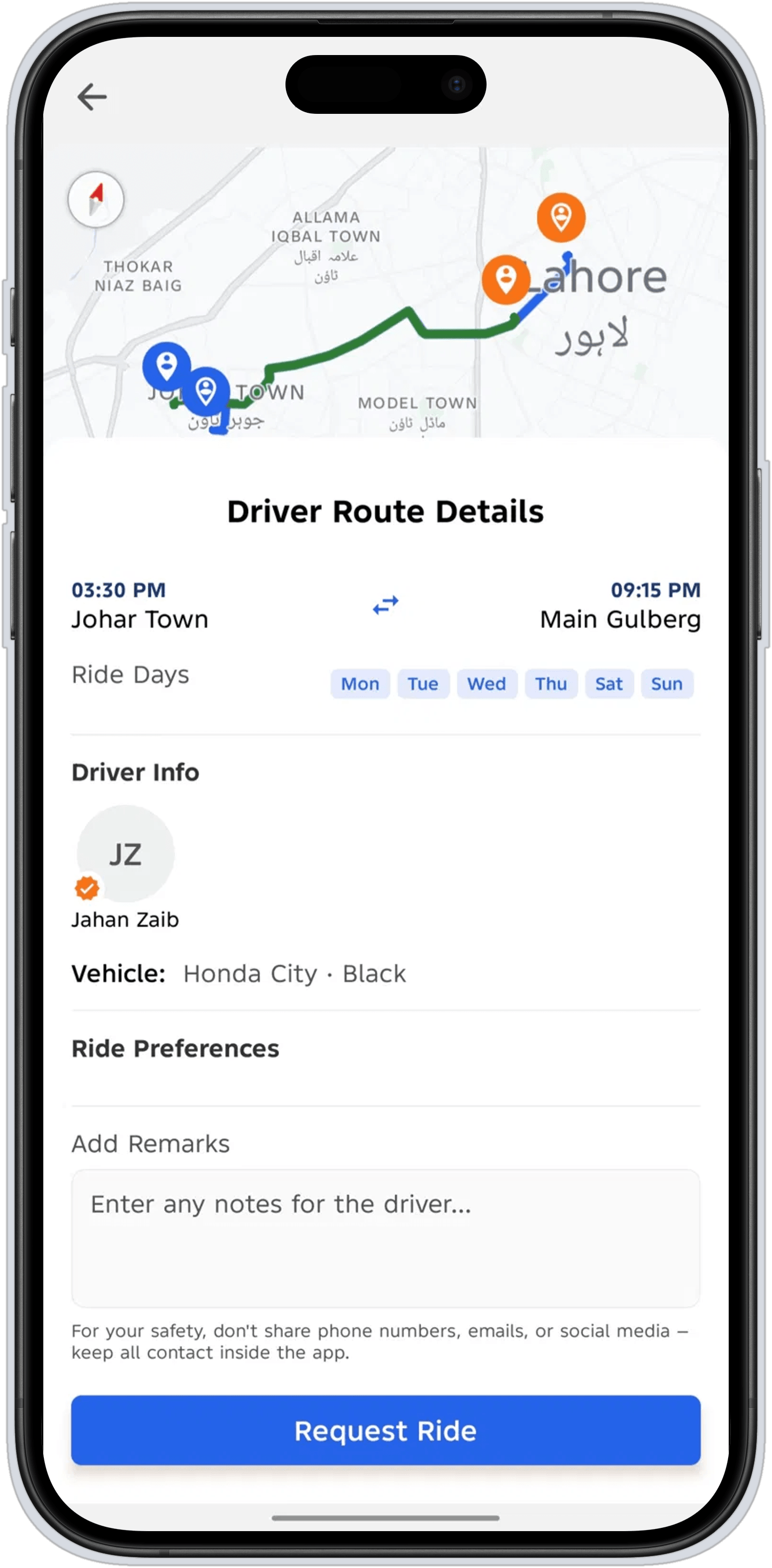
You see everything before you commit. Tap any ride and you get the full picture: the driver's route drawn on the map, their name and verified badge, their vehicle ("Honda City · Black"), their schedule, and exactly where your pickup sits on their route. No surprises at the roadside.
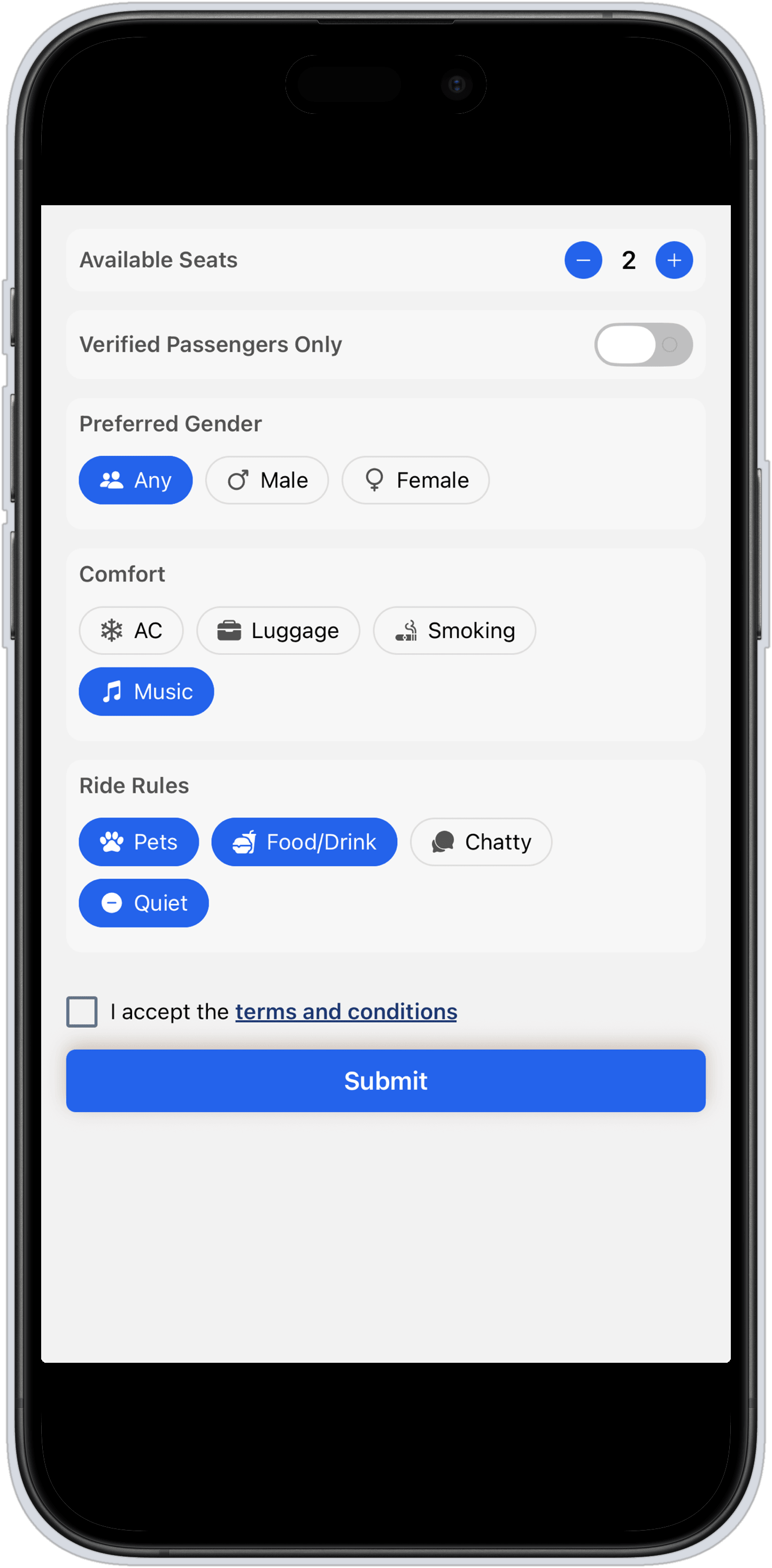
Designed for women commuters. In Pakistan, trust isn't gender-neutral. For many working women, "who is in the car" isn't a preference — it's the deciding factor between commuting and not commuting at all. That's why gender is built into RideMate's core matching, not bolted on: passengers specify male and female seats when requesting a ride, drivers can set a preferred passenger gender or open their car to verified passengers only, and every ride card shows the gender make-up before anyone books. A woman searching for her daily office carpool sees at a glance which rides work for her.
Honest pricing, down to the rupee. Every fare is calculated per seat, per trip, from the actual route distance — and both sides see the same math. When a driver receives a request, the app shows the fare per head, the subtotal, RideMate's 10% share, and exactly what the driver takes home. No hidden commissions, no surge games. Fair for the rider, transparent for the driver, sustainable for us.
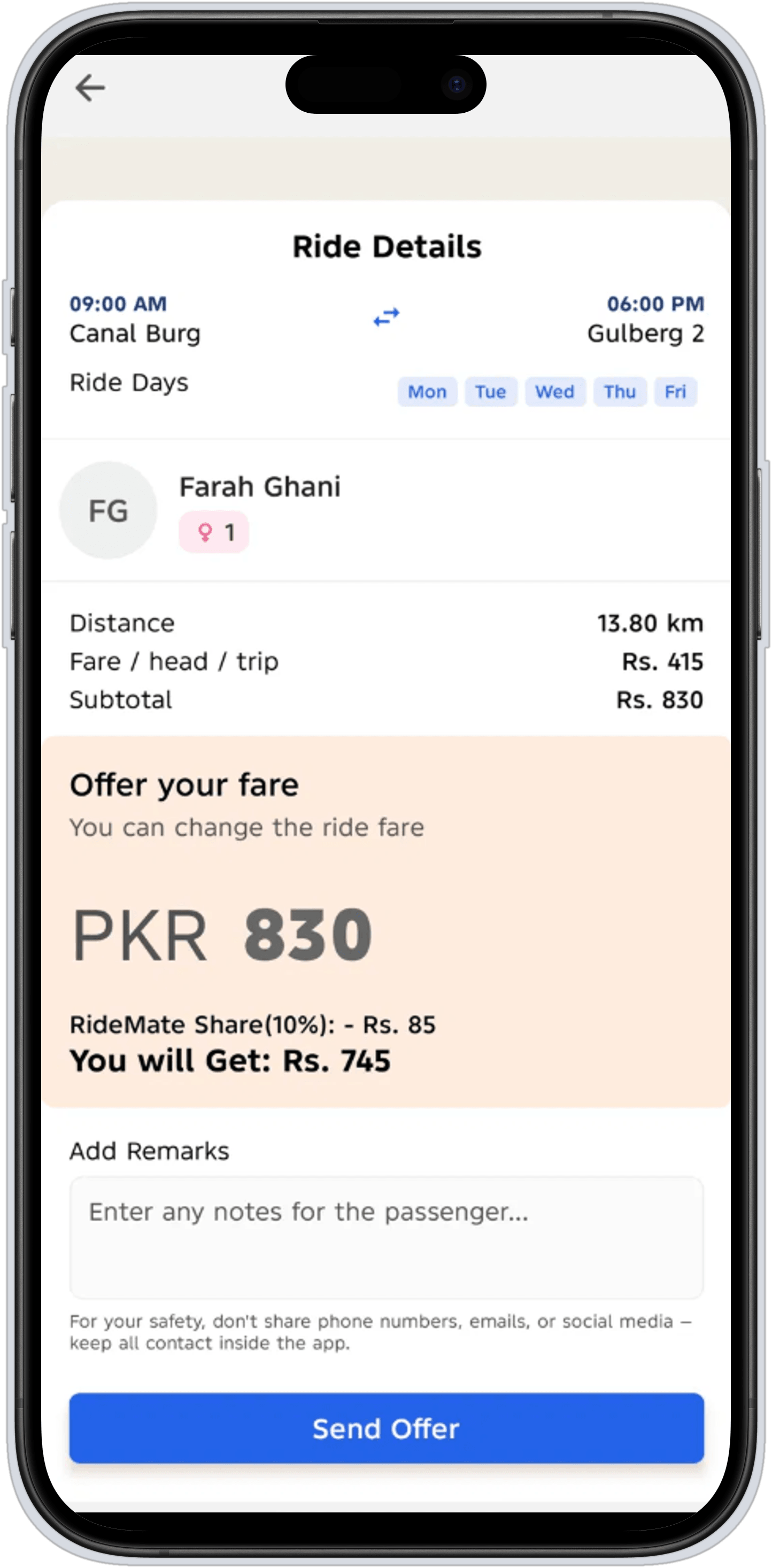
Safety by default. All contact stays inside the app — RideMate actively reminds users not to share phone numbers, emails, or social media. Chat, offers, and coordination all happen where there's a record and recourse.
Set it once, forget it
Nobody wakes up thinking "I should open my carpool app." They wake up thinking "I need to get to work."
That's why RideMate is built around Daily Route Rides, not one-off trips. You set up your commute once — home, office, reporting time, and your working days — and the app matches you with drivers running the same corridor on the same schedule. Your regular matches then live on your home screen: same driver, same pickup, same time, Monday to Friday. No searching, no negotiating, no remembering.
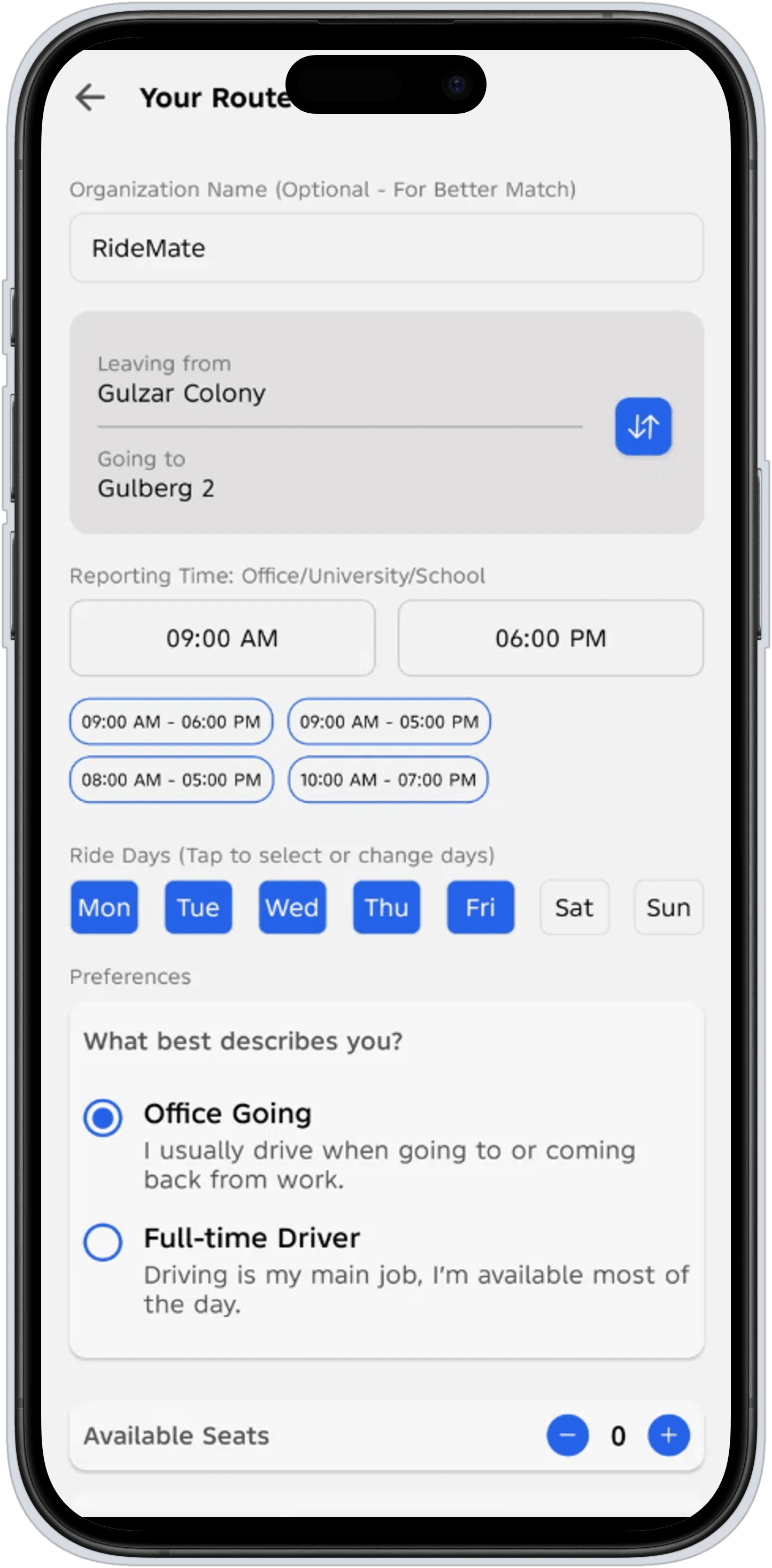
There's a small detail in that flow we're especially proud of: riders and drivers can add their organization name for better matching. Colleagues from the same office, hospital, or university get matched together — and someone verified through their daily workplace commute is a far stronger trust signal than an anonymous profile.
Next, we're taking this further: automatic evening matching for the next morning, and standing arrangements between riders and drivers who keep matching. That's when carpooling stops being an app and starts being a routine.
Let's talk numbers
Because "carpooling saves money and the environment" is easy to say. Here's what it actually looks like in Pakistan in 2026.
The fuel math. Petrol is hovering around Rs. 297 per litre as of this writing — it moves every fortnight, but the shape of the math doesn't. An average car doing 12 km per litre burns roughly Rs. 25–32 per kilometre in fuel alone. Take a typical urban commute — say 15–20 km each way. That's 30–40 km a day, or Rs. 750–1,000 in fuel every single working day. Rs. 15,000–20,000 a month, just to sit alone in traffic.
And it's printed on every ride card in the app. A daily 15.5 km Thokar Niaz Baig–Gulberg III carpool at Rs. 840 per day shows an estimated monthly saving of Rs. 18,190+ compared to travelling solo. A 13.8 km route works out to Rs. 415 per seat per trip — roughly Rs. 30 per kilometre, a fraction of what a solo ride-hailing trip costs on the same corridor. These aren't projections on a pitch deck; they're live numbers our riders see before every booking.
The carbon math. Every litre of petrol burned releases about 2.3 kg of CO₂. A 40 km daily commute produces around 7.5 kg of CO₂ — per car, per day. When commuters who would each have driven (or taken separate cabs) share one car instead, that's roughly 15 kg of CO₂ avoided every day, or over 3.5 tonnes a year — from a single daily carpool.
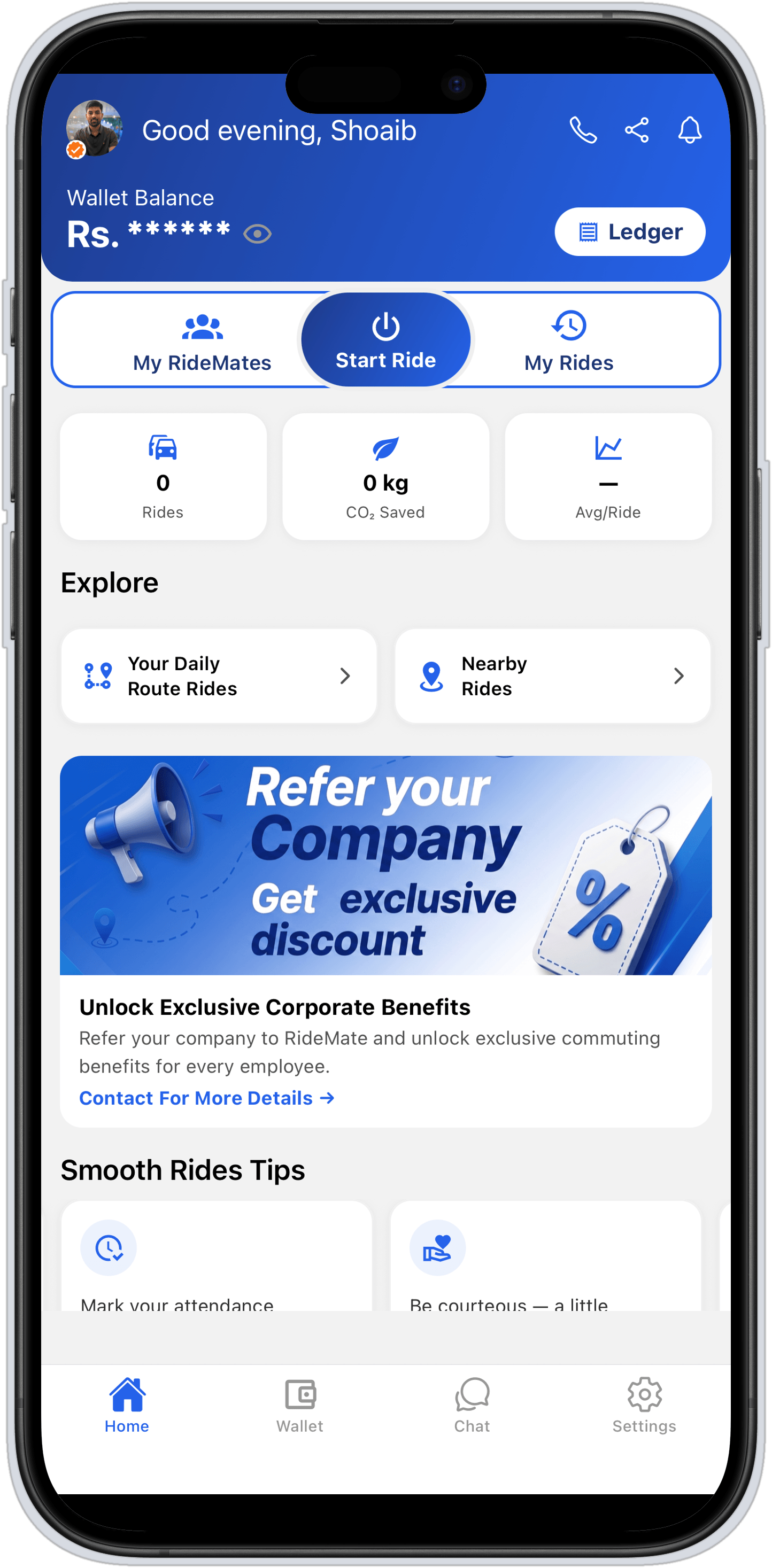
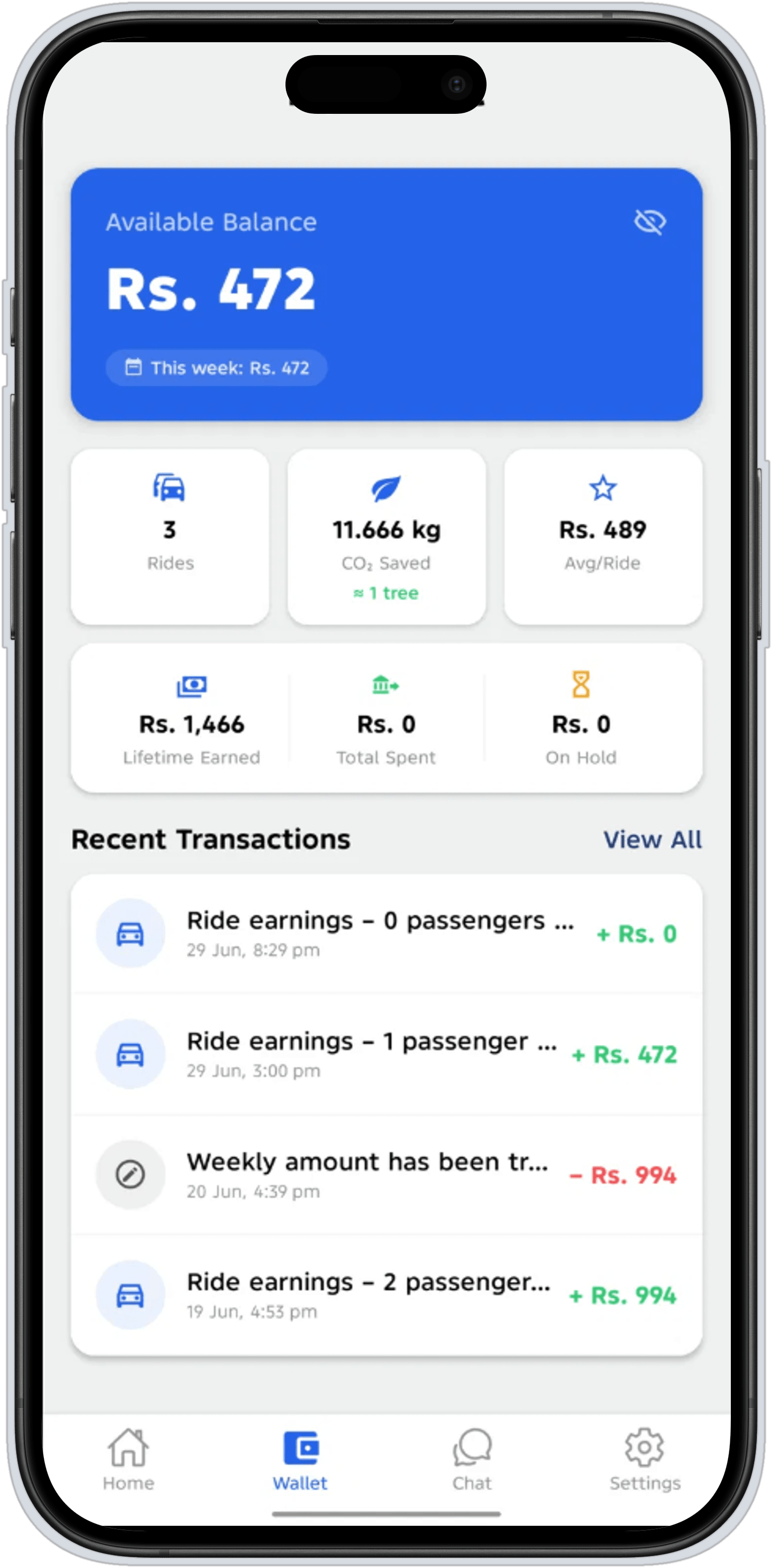
We don't just claim it — we show it. Every RideMate wallet tracks your personal CO₂ saved, ride by ride. One of our drivers saved 11.6 kg of CO₂ — the work of roughly one tree — in just his first three rides. Alongside it: rides completed, average earnings per ride, and lifetime earnings. Your impact, and your money, visible in one place.
Why it matters here more than almost anywhere. Transport accounts for around 28% of Pakistan's carbon emissions, and private road vehicles make up the overwhelming majority of that. In Lahore — a city of over 6 million registered vehicles that regularly ranks among the most polluted in the world — studies attribute anywhere from a third to nearly half of air pollution to vehicle emissions. In Islamabad-Rawalpindi, transport's share of harmful particulate emissions has been estimated at over 50%. Every empty seat we fill is a direct, measurable subtraction from that.
What RideMate has already done. Across our 15,000+ completed rides, our conservative estimates put the community impact at hundreds of thousands of solo kilometres avoided, tens of thousands of litres of fuel not burned, and over 40 tonnes of CO₂ kept out of the air — along with millions of rupees kept in commuters' pockets instead of fuel tanks. And we're only four cities in.
The part nobody sees
Here's my favourite thing about this model: every shared ride is invisible infrastructure.
One fewer car on Shahrah-e-Faisal at 8:30am. A few hundred rupees staying in a household budget instead of burning as fuel. A little less smog over Lahore in November. Fifteen thousand rides in, those small wins are starting to add up to something a city can actually feel.
Where this goes
Today: 15,000+ rides, 750+ active riders, four cities, and a product where verification, transparent pricing, gender-aware matching, and impact tracking aren't promises — they're shipped. Tomorrow: every major commuter corridor in Pakistan, and a platform where sharing a ride is as normal — and as trusted — as hailing one.
The cars are already on the road. The seats are already empty. The routes are already being driven, every single day.
We're just making it possible for people to share them.
RideMate is a seat-sharing carpooling platform operating in Lahore, Islamabad, Rawalpindi, and Karachi. If you commute daily and you're tired of paying solo prices for a shared problem — come ride with us.